Learn about Wikipedia’s strengths, weaknesses, and how to assess article quality
Table of Contents
Wikipedia is everywhere. Whether you are searching for your favorite athlete, researching a nonprofit’s background, or exploring ancient history, a Wikipedia article is almost always a top result. You see it on search engine results pages (SERPs), AI platforms like Perplexity, ChatGPT, and Gemini, and even in news articles. But the famous platform isn’t without its share of controversy. The question we need to answer is how accurate is Wikipedia? Let’s get right to it.
How factually accurate is Wikipedia?
Wikipedia can be accurate for many topics. This includes historical persons and events, as well as modern individuals and organizations. Accuracy is improved when topics are well-documented outside of Wikipedia and there are many reliable sources to use to build out a page.
However, just because it can be accurate doesn’t mean it always is.
Should I trust Wikipedia?
Wikipedia is not always accurate, and there are a number of reasons why:
- An editor can misunderstand sourcing and add incorrect information to a page
- A source can be mistaken and provide inaccurate information
- An editor can choose not to use a source and either knowingly or unknowingly add information to a page that isn’t accurate
- A topic can be a source of intense debate which results in edit warring and leaves a page unreliable as information is edited and changed constantly
On top of all of that, another possible trust-issue is caused by Wikipedia’s open-editing policy, which is both a strength and a limitation of the platform.
Wikipedia’s Open-Editing Policy
Wikipedia is editable by anyone, which means there are many editors helping to monitor for vandalism and errors, and also contributing to article discussions and building out articles to be as comprehensive and accurate as possible. This is great, as no one person or group could hope to achieve growth on the same scale as is made possible by a global editing cohort. However, it does introduce some issues.
You see, if anyone can edit, there’s an inherent risk for vandalism, unchecked errors, and bias. Every editor brings his or her own biases to Wikipedia. If these biases aren’t checked, pages lose their neutrality and instead become promotional or disparaging. This degrades the page’s credibility.
Wikipedia’s articles aren’t reviewed by vetted panels of experts. Editors do their best to help one another and to work together to resolve any questions about articles, but it isn’t an easy or a fast process. Sometimes issues arise due to an editor operating in good faith who doesn’t know they’ve made a mistake. Other times malicious actors intentionally vandalize articles. Issues can exist for long periods of time before being noticed and corrected.
When it comes to Wikipedia, think of the adage made popular by Ronald Reagan, “Trust, but verify.”
Do Wikipedia pages exhaustively cover all topics?
Wikipedia does not exhaustively cover all topics. It is an encyclopedia, which means the information it provides is meant to be high-level and notable. There will be details about a person, place, or thing that Wikipedia will not include.
Use Wikipedia as a starting point for information and research. Then use its references and other related source material to continue learning.
Wikipedia’s Strengths and Weaknesses
Here are some of Wikipedia’s strengths and weaknesses. The platform’s had many years to improve its processes and continues this work today.
STRENGTHS
WEAKNESSES
Strong Sourcing Requirements: Wikipedia requires that everything added to an article be verifiable by third-party, reliable sources. There must be references that any user can check. (This is a strength when the policy is followed.)
Uneven Distribution of Editors: Some Wikipedia articles fascinate multiple editors. They are strongly built out, well-organized, and updated as needed. Other topics are barely perused and pages can be incredibly sparse or even unreliable with unchecked errors.
Wide Coverage: Wikipedia has millions of articles covering everything from pop culture and current events to archeology and zoology, and everything in between.
Source Inequality: While Wikipedia’s sourcing requirements are a strength, not all sources are made equal. If editors use a weak source, or make up a source, article copy is not reliable.
How to Assess Wikipedia Article Quality
Here are the steps to follow if you want to assess whether a Wikipedia article is reliable or not:
1. Check the page for tags. Tags are located at the very top of the page. A tag might alert readers to a possible problem – such as a detected bias – or they might be a request for help. Here are two examples:
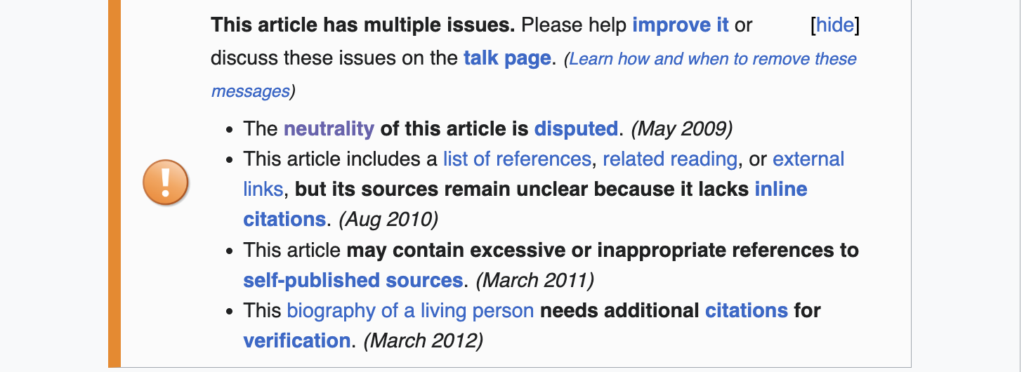
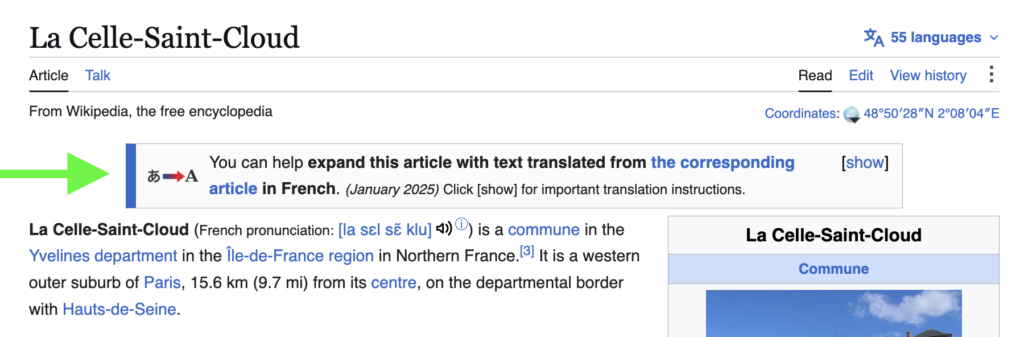
If the article does have tags, when were the tags added? Has anyone edited the page since then? Sometimes editors will see a tag and take steps to improve a page, but forget to remove the tag.
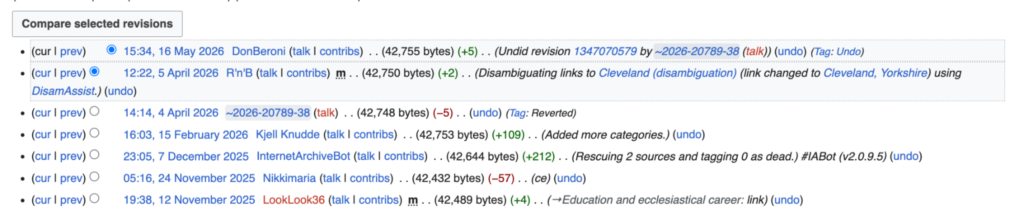
2. To find out how recently the page was edited, click on ‘View history.’ This brings you to a page with a list of every edit ever made to the page. You can see the date of the edit(s), the editor’s username, and, sometimes, a brief description of what changed.

3. Review the page’s references. Is copy well-sourced? Are references from reputable third-party sources such as academic journals and major news outlets? Are the facts on the page actually in the source?
4. Is the page written in a neutral manner or is there obvious positive or negative bias?
5. If the page deals with breaking news, be cautious. Ongoing situations change quickly and Wikipedia may not be completely up to date.
By following these best practices, you can determine how reliable or not a Wikipedia article is, and whether or not it needs to be improved.
Doing More with Wikipedia
If you want to get more involved with not only reading but also editing Wikipedia, check out more of our resources.