A Strategy for Communications Leaders
Your company’s Wikipedia page no longer reflects the business today. With leadership questioning, “Why?” and search engines and AI models surfacing obsolete company details, the immediate instinct is to draft a complete rewrite and implement the fix ASAP.
This is the wrong move. Treating Wikipedia like a corporate website or PR channel usually leads to reverted edits, warning tags plastered across the page, and/or blocked editing accounts. Wave goodbye to your chances of influencing the page at all.
What you need to do to navigate this platform effectively is shift your mindset from direct content control to community-driven collaboration. Your Wikipedia page is, in all practicality, a publicly-owned document. Improving it requires more than adding better copy. It requires understanding how community discussions take place, the sourcing behind existing content and potential changes, and the history of previous edits and discussions.
We’re going to give you a breakdown of how companies should strategically approach an outdated Wikipedia page with these elements in mind.
TL;DR
- The Problem: Outdated Wikipedia pages misrepresent your company in search results and across AI tools like ChatGPT, Gemini, and Perplexity.
- The Way Forward: Companies can participate in updating their pages, but must disclose their COI, and cannot treat Wikipedia like an owned PR channel.
- Understand Before You Act: Before taking action, research your page’s revision history to guide how you plan your approach.
- Isolate Each Problem: Do not submit a massive redline document as this will only overwhelm volunteer editors and signal a desire for corporate control.
- Make Changes Easier for the Community: Break edit requests into small, digestible pieces and rely strictly on independent, high-quality secondary sourcing (not press releases).
- Think in Terms of Meaningful, Durable Improvement Over Time: Reframe your idea of success from that of a marketing brochure look-alike to a page that is factually accurate and provides balanced context to your public reputation.
Table of Contents
Why Wikipedia Matters
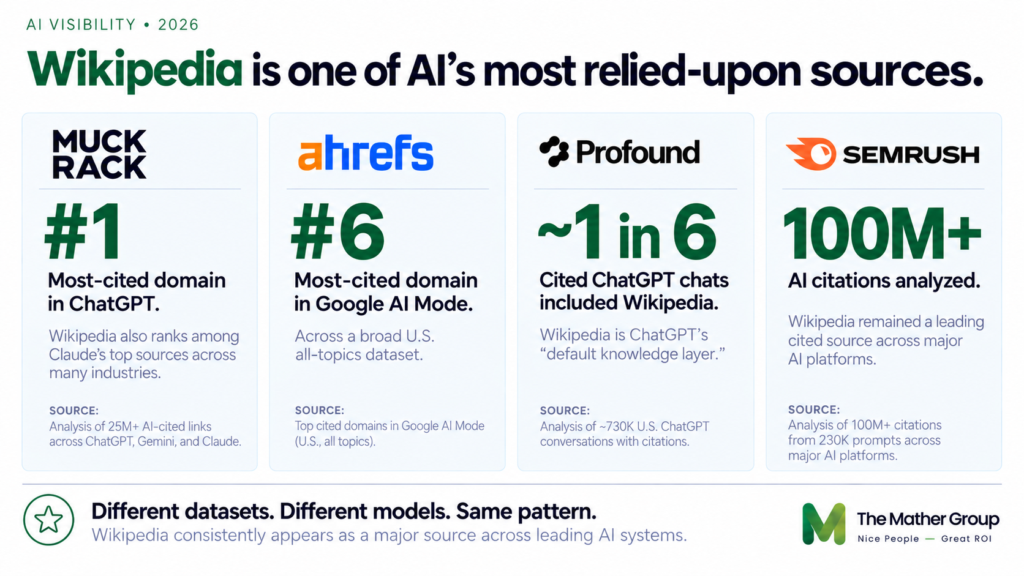
Wikipedia is one of the most widely used sources of entity-level information on the internet. It delivers:
- Global authority and usage: Wikipedia remains one of the most visited websites in the world. It often serves as the default reference layer for basic factual context and its authority makes it a no-brainer for AI platforms to target.
- Structure and machine readability: Wikipedia’s markup, standardized formatting, internal linking, and citation patterns make it easier to parse and retrieve from reliably. Wikidata further enhances this by providing structured facts that can be used by knowledge graphs and LLM retrieval systems.
- Search result dominance: Wikipedia pages frequently rank highly on search engines, whether you are searching for people or companies. This makes them consistently accessible to both users and machines.
- Utility in retrieval systems: Academic and commercial retrieval-augmented generation systems (RAG) often use Wikipedia content as a core reference dataset because it helps ground answers in facts and reduce hallucinations. Microsoft, Meta, Amazon, Perplexity, Mistral AI, and Google pay the Wikimedia Foundation for high-volume API access to Wikipedia.
With this level of attention and influence, outdated pages cannot be ignored.
The Problem: The Page No Longer Represents the Company Today
The four most common issues with outdated pages are:
- Key facts about the company are outdated or incomplete
- Major developments are missing or underweighted
- Older events or controversies still receive disproportionate attention
- The article’s structure and emphasis no longer match what is most important about the business today
The Wikipedia problem: Someone reading this information would walk away with the wrong understanding of who you are. However, the problem doesn’t stop there.
The global problem: Since Wikipedia serves as a primary source of factual information for search engines and AI models like ChatGPT, Gemini, and Perplexity, outdated pages feed inaccurate information directly into AI answers and overviews. Users read that and may never visit your actual website.
The complication: Wikipedia is not an owned asset. It operates under strict community guidelines regarding Conflict of Interest (COI), verifiability, and neutral point of view. Because anyone with a connection to a page is strongly discouraged from directly editing, successfully updating a page requires collaborating knowledgeably with Wikipedia’s volunteer editor community.
The first step: Reviewing a page’s revision history.
What Page History Tells You Before You Make a Move

Before drafting any changes, it is important to research the article’s revision history and talk page discussions. Rarely are you starting a new conversation with your revision wishes. More often than not, you are entering the middle of an ongoing one, and it’s best to acknowledge and respect that.
Checking the page history reveals crucial context that will guide your strategy moving forward:
- Prior Attempts: Have previous PR agencies, employees, or contractors already attempted to edit or rewrite the page? Reverted edits or past warnings indicate existing scrutiny, and are a heads up that this could be an uphill battle. Editors are not trying to make your life difficult. From their point of view, it’s the other way around. They see past, nondisclosed COI edits as an attempt – malicious or otherwise – to usurp Wikipedia’s authority and place it under a brand’s control. They want Wikipedia to remain neutral and unbiased so that it remains trustworthy. You need to show that you want that too.


- Page Stability & Controversy: Are there certain areas on the page that have caused editing issues in the past? Perhaps debates over lead sections or criticism sections? Maybe even edit wars with edits being made and reverted in quick, repetitive succession? If yes, editing these areas will require extra care and by-the-book neutral sourcing and copy.
- Active Editors: Are there certain regular contributors to the page? Understanding these editors’ actions and community reception to page changes helps you craft proposals that respect community norms. For this information, you’ll need to familiarize yourself with the Talk page.


Companies are Allowed to Participate in Wikipedia Edits

There is a common misconception that anyone who works for a company is not allowed to do anything about its Wikipedia page. This is not true. There are COI guidelines to help companies navigate this very situation.
What you should not do is wholesale rewrite the article according to how your company thinks it should read. This will get you into trouble.
Wikipedia is built around collaborative editing, discussion, proposed changes and consensus. This is your way forward. There is room for you at the table. But you need to understand both the written and unspoken rules.
When Editing Your Own Page or Brand (COI Editors)
1. Declare Your Connection: Create a user account and practice transparency. Publicly state on your user profile who you work for or represent, or whatever COI connection you have.
2. Use the “Talk” Page: Go to your target article and click on the Talk tab.

3. Submit a Formal Edit Request: Write a polite message, clearly explaining your COI, what you’d like changed, and why. Think of something like, “Hello. I work for [BRAND]. This Wikipedia page currently states [X], but according to these reliable sources [INSERT], the page should say [Y]. Could an independent editor please update this?”
If you don’t want to change anything, but instead want something new added, consider something like, ““Hello. I work for [BRAND]. I believe this [NOTABLE FACT] is missing from the Wikipedia page. It can be found in these reliable sources [INSERT]. Can an independent editor make this change?”

4. Wait for Review: Sit back and wait for the community to chime in. This could happen quickly, or not, depending on a number of factors. Be patient. Also be prepared to be flexible. Another editor might not agree with your request. It may take some back-and-forth for you to see change.
Why a Redline is a Starting Point, Not the Strategy
Drafting an internal redline can help your team identify what is inaccurate, missing, or unbalanced. However, submitting this entire document, at once, to Wikipedia is counterproductive.
- It Overwhelms Reviewers: Volunteer editors do not have the time nor the inclination to wade through a massive, all-or-nothing rewrite.
- It Mixes Strong Requests with Weak Ones: Factual, easily supported requests can get overlooked if they are surrounded by edits with far less chance of being accepted. Individual issues become more difficult to evaluate.
- It Signals Corporate Ownership: Most often, rewrites read like PR copy. This is immediately going to trigger resistance from editors who defend the platform from promotional editing.
- It Obscures Sourcing: Wikipedia requires independent, reliable sourcing. Its guidelines reject press releases, company blogs, affiliate posts, and the like. A massive redline makes it difficult for editors to verify individual claims against provided references. If they have to try too hard, they’re going to stop.
Pro Tip: Thoughtful changes are easier to evaluate when they’re presented in digestible, distinct ways.
How to Approach Page Improvement

Rather than presenting your entire (possibly demanding) redline document, approach changes with incremental, well-supported requests. Your page improves through a series of decisions, not one rewrite.
1. Break the Redline into Digestible Pieces: Different issues carry different levels of support. A factual correction, missing development, structural concern, or controversial section are not the same problem.
Start with straightforward corrections such as leadership updates. Save broader narrative adjustments for later, when you’ve developed a relationship with Wikipedia editors and understand how requests must be presented. Be prepared to move at the rate of one sentence at a time.
2. Evaluate Sourcing for Each Claim: Some questions are more sensitive than others. Before requesting the change, look at overall importance, prior editor attention, and how supportable the change really is. Ensure that every proposed addition or modification is directly backed by independent, non-promotional sources. If it isn’t, the community is not going to approve the change.
Sources typically rejected by editors include:
- Press releases
- Company blogs
- Sponsored posts
- Interviews with brand reps
- Paid content or affiliate sites
- “Announce-only” articles (e.g. PRNewswire)
Sources accepted by Wikipedia include:
- New York Times
- Wall Street Journal
- Wired
- Harvard Business Review
- Peer-reviewed journals
- Long-standing independent news outlets
3. Engage via Official Community Channels: Submit your proposed edits and sourcing via the Talk page. Disclose your COI along with the request and wait for other editors to review the changes. They may implement immediately or engage in discussion, with you and each other, if necessary.
4. Let the Response Inform What Comes Next: Wikipedia is collaborative. The community response you receive each time shapes what request makes sense next. Every time you engage successfully – whether your change is implemented or you have a respectful, let’s-learn-from-each-other conversation – you build credibility and set a constructive tone for subsequent discussions.
Pro Tip: The page can become materially better without becoming perfect. Improvement is often cumulative. You are managing participation in an important public document over time, not managing one absolute edit.
What a Successful Outcome Realistically Looks Like

Success is not defined by converting your company’s page into a corporate brochure or removing all negative material because this will never happen. Wikipedia’s rules and guidelines prohibit such change. If a page was completely rewritten in such a manner, it would be reverted to a previous edition or deleted. The company could even see themselves prohibited from having a page in the future.
The Mindset Shift: Reframe your idea of success based on what makes sense for a lasting encyclopedic presence. You are not simply updating a company profile. You are managing a public representation of your company by guiding a dynamic platform that evolves over time and remains outside your direct control.
What Success is NOT | What Success Realistically IS |
Having every requested edit implemented exactly as written | Missing details are added, and older events and controversies are contextualized fairly within the article’s broader structure |
Matching the company’s marketing language word-for-word | Crucial facts, key developments, and current leadership are correctly reflected |
Meeting fixed internal corporate deadlines | Changes are implemented through community consensus, giving them a far greater possibility of remaining on the page |
In Brief: It’s Your Page, But You Don’t Own It
Wikipedia is a strategic asset that deserves your time and attention. By embracing its collaborative, community nature, and giving it the white-glove treatment, you can build successful changes over time.
Frequently Asked Questions (FAQs)

If your company’s Wikipedia page contains outdated or inaccurate information, don’t immediately rewrite the page or make the changes yourself. Start by reviewing the article’s revision history and Talk page to understand previous edits, discussions, and any areas that have been particularly contentious. If you have a conflict of interest, disclose your connection and submit specific, well-supported edit requests through the Talk page rather than directly editing the article. Break larger updates into smaller, digestible requests and support each proposed change with reliable, independent sources. Wikipedia’s community ultimately decides whether and how changes are made, so the goal should be to make thoughtful, well-sourced improvements over time, not to turn the page into a company-controlled profile.
Directly editing a page where you have a Conflict of Interest violates community guidelines. These edits are frequently reverted and aggressive editing can lead to blocked IP addresses, account bans, and warning tags placed atop your company page.
Wikipedia is not only asking whether a replacement fact is true. It is asking:
- What do reliable sources support?
- Is the new information notable enough to warrant inclusion in the article?
- Is it neutral and appropriately weighted?
- Does the proposed wording fit Wikipedia’s encyclopedic style?
Bottom line: The goal is not just factual accuracy. It is encyclopedic accuracy, relevance, and support.
The risk of undisclosed COI editing on Wikipedia is not just that your edit gets reverted. Instead, you can expect:
- Company editor accounts blocked or banned
- Company IP addresses blocked
- The company loses credibility with the editor community
- The article receives visible warning tags that signal concerns about neutrality, promotional editing, or company involvement
- Aggressive editing can create a complicated revision history that future update attempts will need to navigate
- What might have been a relatively straightforward update can become a much harder problem to unwind, both now and in the future, if editors are suspicious of your motives
Bottom line: A rushed attempt to fix the page can make the issue more visible, more complicated, and harder to solve later.
Wikipedia relies on volunteers to drive the editorial process. Meaningful changes are reviewed and shaped through community participation and consensus. Different issues may involve different sourcing, history, and levels of contention. It is best to break the work into digestible pieces to make it easier to engage editors and reduce multiple concurrent disputes.
Bottom line: The page improves through a series of thoughtful editorial decisions, not one company-led rewrite.
Wikipedia prioritizes independent sources in order to preserve article neutrality. It cares about more than where you were covered. It also cares about what kind of coverage you have:
- Strong earned media is most useful when it is independent, substantive, and focused on the company or issue itself
- Every article in a top-tier publication will not automatically be useful for Wikipedia
- Brief mentions, announcement coverage, interviews, and articles built largely from company-provided information may have limited value
- The stronger the proposed change, the more important it is to have coverage that directly supports the significant, context, and weight of that change
Bottom line: It is not just about having coverage in good publications. It is about the right kind of earned media coverage for the change you want to make.
Wikipedia is an independent editorial process where every editor has their own opinions and biases that influence how they interpret the guidelines and a specific request.
A strong, well-supported proposal can be:
- Accepted as written
- Revised
- Partially accepted
- Challenged
- Rejected
You can control the quality of your sourcing, your reasoning, and your approach. You cannot control how independent editors ultimately reach consensus.
Bottom line: You can improve the odds of a strong, durable outcome by following the rules. You cannot guarantee an editorial decision in your favor.