TL;DR
In March 2026, English Wikipedia officially banned the use of Large Language Models (LLMs) to create or edit articles, with only minor exceptions permitted for copyediting and translation. This new policy delivers two critical operational realities:
- You cannot use ChatGPT to do Wikipedia: The same goes for Gemini, Claude, or any other AI platform du jour. You might think you’re streamlining your brand’s visibility, but Wikipedia sees it differently. You’ll be called out for violating core policies and trigger fast, take-no-prisoners crackdowns from human editors.
- Editors are using the AI ban to speedily remove information: There is no way to prove something was AI, which means editors don’t need proof to make an AI accusation. Mere suspicion is enough to immediately delete content, even well-sourced content.
AI wouldn’t be where it is today without Wikipedia. The world’s famous (sometimes infamous) online encyclopedia helped train many of our AI systems.
Now, the tables have turned. Wikipedia is formally restricting the use of AI-generated content on the platform.
At first glance, that might seem inconsequential, like nothing more than an operational Wikipedia policy update. Brush this under the rug at your own peril, though. Wikipedia’s decision represents a strong commitment to protect the platform from inferior, untrustworthy content.
If content is even suspected of being LLM-generated, regardless of sourcing, out it goes.
As soon as generative AI made a splash, people questioned what would happen to Wikipedia. Would it slowly erode, would it become infested with AI slop, would it lose editors…
Its passionate community has now spoken publically: Wikipedia is not going anywhere and they will not allow AI to ruin years of hard work from dedicated human editors.
What Actually Changed
Protecting the platform and its reputation is why, in March 2026, English Wikipedia editors approved the policy change prohibiting the use of LLM-generated or AI-rewritten article content under most circumstances.
The new guidance places significant restrictions on the use of generative AI for creating or rewriting Wikipedia article content.
“Text generated by large language models (LLMs) often violates several of Wikipedia’s core content policies,” an article on Wikipedia reads. “For this reason, the use of LLMs to generate or rewrite article content is prohibited, except for basic copyedits and translation of materials from other language Wikipedias as outlined below.”
AI-generated content is seen as a potential attack against Wikipedia trustworthiness and reliability because of tendencies such as:
- Fabricated or inaccurate information
- Fake or misrepresented citations
- Subtle bias and neutrality problems
- AI-generated text that “sounds correct” while containing factual errors
- The overwhelming verification burden created for volunteer editors
The only exceptions to the use of AI-generated content on Wikipedia are:
- Editors are permitted to use LLMs to suggest basic copyedits to their own writing, and to incorporate some of them after human review, provided the LLM does not introduce content of its own. Caution is required because LLMs can go beyond what is asked of them and can change the meaning of the text such that it is not supported by the sources cited. Examples of basic copyedits include spelling, punctuation, and capitalization.
- Editors are permitted to use LLMs to translate articles from another language’s Wikipedia into the English Wikipedia, but most follow the guidance laid out at Wikipedia:LLM-assisted translation. (This guidance includes but is not limited to being “skilled enough” in both languages to confirm accuracy.)
You Cannot Use AI for Wikipedia

Verifiability, sourcing, and editorial scrutiny have always been the bedrock of Wikipedia. Its standards remain non-negotiable.
The word is out: for Wikipedia, human verification still matters.
Brands frequently think using ChatGPT, Claude, Gemini, or Perplexity to draft Wikipedia content will save them time and headaches. Why take the time to learn Wikipedia’s many guidelines, policies, and idiosyncrasies when a machine can do it for you?
However, it’s for these very reasons that LLMs inherently struggle with Wikipedia. They aren’t formatted to work within the encyclopedia’s core policies:
- Neutral point of view – All Wikipedia articles and other encyclopedic content must be written from a neutral point of view, representing significant views fairly, proportionately and without bias.
- Verifiability – Material challenged or likely to be challenged, and all quotations, must be attributed to a reliable, published source. In Wikipedia, verifiability means that people reading and editing the encyclopedia can check that information comes from a reliable source.
- No original research – Wikipedia does not publish original thought: all material in Wikipedia must be attributable to a reliable, published source. Articles may not contain any new analysis or synthesis of published material that serves to advance a position not clearly advanced by the sources.
LLMs inherently struggle to provide neutral, unbiased information. They can provide proof of sourcing, but that sourcing often pulls from branded content, press releases, and user-generated platforms – all of which fail Wikipedia’s reliable sourcing guidelines. As for the encyclopedia’s other policies, they are not locked in stone, but are dynamic and highly contextual. Understanding this context takes a human perspective built through experience, trial and error, and time editing.
AI-generated content might look good, but its quality fails the encyclopedia’s standards. Use AI and you’re inserting tripwires into your content. As soon as an editor stumbles across one, things will go up in smoke, fast.
Deletion Without Proof
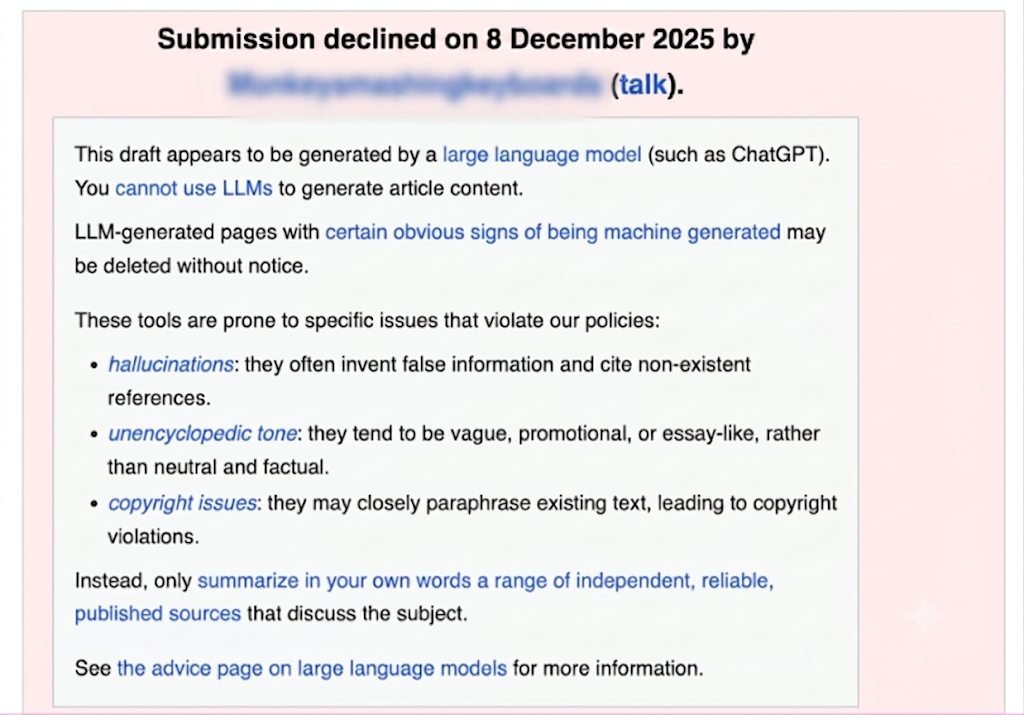
There is no definitive technical test to identify AI text. Because editors cannot prove content is AI, they don’t need to prove it. Even if content is accurate and backed by high-quality sourcing, if an editor suspects an LLM wrote it, that’s enough to justify one of two things:
- A speedy deletion of the suspected content
- The addition of a tag on the article, branding it as suspected of AI-generative content

These rules apply for both changes to articles and submissions of new drafts.
Possible AI Triggers
There is no exhaustive list we can provide because this space is so subjective, but here are a few important points:
- If you copy + paste content into the visual editor or source editor on Wikipedia, it leaves a record. That record is being used as evidence that the content was written by an LLM.
- Often, editors will pull whatever they can from this policy guide to explain themselves. However, as even this guide says, it is descriptive, not prescriptive. It points out potential signs of a problem. This means a human editor could write completely without AI, unknowingly write in this style, and run into someone who questions their work.
- We’ve also seen Talk page conversations between editors where editor responses are suspected of being written by AI. This is often because those responses are seen to be avoiding questions overall, or focused on finding out how to avoid AI detection.
Bottom Line: If you aren’t completely aboveboard and careful, it’s all too easy to fall into trouble.
Overworked Editors
Wikipedians are overwhelmed by the threat of AI-slop overtaking and degrading the encyclopedia. Content reviews happened before AI and required a lot of editors’ time. With the speed with which AI text can be generated, the potential for untrustworthy content to spill across the platform is significantly amplified.
Consider a scenario where one LLM generates 50 pages of content in one day for one human interested in editing Wikipedia. That is astronomically more than the human could do on its own, if s/he was following Wikipedia’s core policies. Once those 50 pages are live, volunteers must spend additional time fact-checking, sourcing, and cleaning up information that may appear credible on the surface but contains subtle inaccuracies or unsupported claims underneath.
This creates a serious operational problem.
Not everyone using AI to edit Wikipedia is nefarious. Some generally think AI knows what it’s doing and they want to improve pages. But good intent doesn’t stop collateral damage.
The new AI ban will hopefully help editors ease their workload while protecting Wikipedia.
Why This Matters Beyond Wikipedia

Wikipedia’s decision reflects a much larger shift happening online.
As AI-generated content floods the web, people are raising their eyebrows. Skepticism, slowly but surely, is nosing its way around. We want to know that what we read and what we see is real. When something, a certain website or platform or source, provides that accountability, we lean in.
Platforms and sources that maintain stronger editorial standards become more influential.
That has major implications for:
- AI-generated search results
- Google AI Overviews
- ChatGPT responses
- Perplexity citations
- Knowledge graph construction
- Entity understanding across AI systems
That is part of what makes Wikipedia so important.
Wikipedia is not simply another website competing for search traffic. It functions more like a foundational trust layer within the modern information ecosystem.
Its sourcing requirements, transparency in its revision history and editorial discussions, and community governance all make it uniquely valuable in an internet increasingly saturated with made-with-one-click AI content.
The rise of generative AI may make platforms like Wikipedia even more influential over time.
What Brands Should Take Away

For communications teams, marketers, and reputation leaders, Wikipedia’s policy change offers several important signals.
1. Enforce strict human oversight on Wikipedia
Do not use LLMs to write content for Wikipedia, and absolutely no copy-pasting from LLMs into Wikipedia.
2. Prioritize independent sourcing
With hyper-skeptical editors, all sourcing must be ironclad. Use only the best third-party citations so your content doesn’t fall under suspect.
3. Focus on quality over quantity
Longer Wikipedia pages are not inherently better than shorter ones. Don’t think you need AI to bulk up a page. Instead, focus on high-quality, human-written edits that add notable information to an article.
4. Wikipedia remains uniquely influential.
Not because it is perfect, but because its editorial model creates a level of transparency and scrutiny that much of the web lacks. Even if site visits are down, as some report, that does not mean Wikipedia’s influence is down. Articles are simply being read in other places, including through AI platforms, rather than only on Wikipedia itself. In fact, Wikipedia continues to rank among the most-cited domains across major AI search and answer systems, which means its content is still shaping what people see, even when they never click through to the site.
Final Thoughts
As AI-generated content becomes easier to produce, credible, human-reviewed sources become more valuable. That is why Wikipedia still matters. Its editorial process is imperfect, sometimes frustrating, and often slow, but it creates a level of scrutiny that most of the web does not have.
For brands, the takeaway is simple: there are no shortcuts. If you want information to survive on Wikipedia, it needs to be accurate, neutral, well-sourced, and written with human judgment. You can’t simply hand the process to an LLM. Companies that understand this will treat Wikipedia less like just another marketing channel and more like part of their broader reputation infrastructure. In an AI-shaped search environment, that distinction matters.